Personal Injury / October field notes
The LSA-to-Performance-Max Transition: A PI Firm Owner's Readiness Guide
A source-checked readiness guide to Google's phased LSA transition, pay-per-lead boundaries, reporting backup and account-level verification.

Prepare for your account, not a headline
Google documents a phased transition from Local Services Ads into specialized Performance Max campaigns with pay-per-lead goals. That is not evidence that every personal injury firm has already migrated. The immediate task is to confirm the status of your own account, preserve information that will not transfer and identify who owns the checks before and after the change. Treat the account notice and current official guidance as operational inputs.
The naming can create avoidable confusion. This transition is not a reason to assume your existing LSA budget is becoming an ordinary, all-inventory Performance Max campaign. Nor is it the same product as AI Max enhancements for Search campaigns. Before approving a change, ask the person managing the account to show the campaign's actual goal, placement scope and billing model.
This article is a readiness procedure, distinct from the broader LSA operating guide. It does not predict your migration date or recommend changing a live campaign without reviewing the account.
What the dated rollout actually says
Google's transition overview identifies an August 2026 first phase for selected US home and storefront service advertisers. Its vertical-eligibility page describes a broader late-2026 phase including professional services, with remaining categories and non-US accounts extending into 2027. These are phased descriptions, not confirmation that a particular firm's transition has happened. Transition overview; phased eligibility.
Keep a dated account record: what notice was received, which administrator received it, the stated migration timing, the current account ID and who verified the information. If the account view and a general article seem inconsistent, resolve that discrepancy with the platform before taking consequential action. Do not use the date a help page was crawled as proof that a new policy began that day.
Our recommendation is to make readiness an assigned task with evidence, not a verbal assurance that the agency has it covered. A screenshot or export tied to the correct account is more useful than a generic migration presentation.
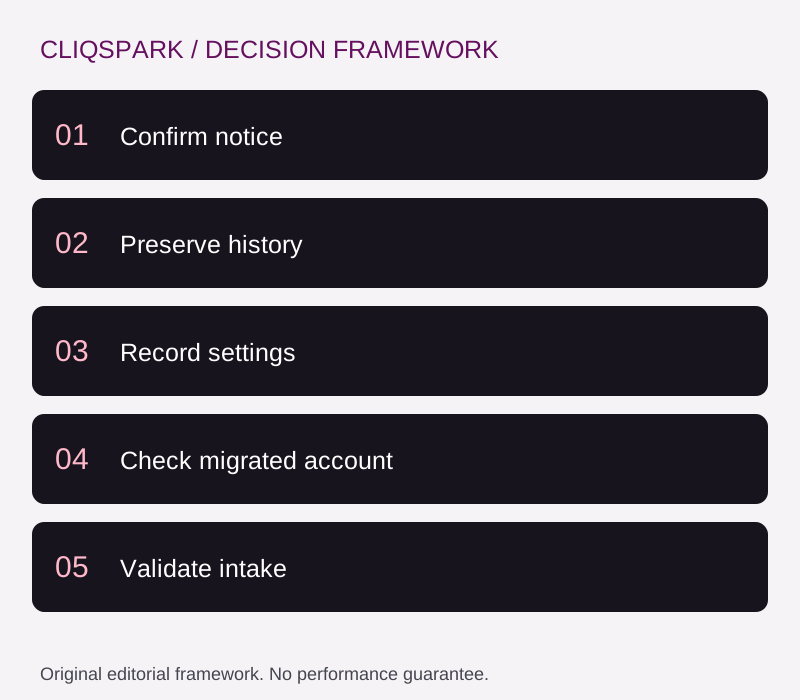
- Confirm notice
- Preserve history
- Record settings
- Check migrated account
- Validate intake
What stays and what needs attention
Google describes continued pay-per-lead charging and Search/Maps placements for this specialized setup. The management interface changes, and historical LSA performance reports do not carry into Google Ads. Preserve the reporting before losing access. Consult the pay-per-lead mechanics documentation alongside the transition overview when reviewing the account.
Separate a platform setting from a business control. A campaign may migrate successfully while calls reach the wrong queue, the firm cannot identify the original source in intake, or staff interpret a new report column incorrectly. The migration checklist should include both the advertising account and the people who receive the inquiries.
Do not assume that every setting deserves to be changed at once. Record the current approved service areas, categories, contact routing, operating hours and budget controls. Then compare them with the post-transition configuration. Investigate differences deliberately. Combining migration with a major geographic expansion makes it harder to determine why performance changed.
The ten checks that make readiness reviewable
Before transition: identify the account administrator; confirm the account-specific notice; preserve historical reports; record approved budget and bidding settings; and document service areas, categories and contact routing. Store exports in a controlled business location rather than a public marketing repository. Include the reporting period and definitions so the data remains usable later.
After transition: verify access and permissions; compare the migrated configuration; confirm the intended call and message destination; reconcile reporting definitions with your tracking; and review inquiry quality with the intake owner. These ten checks are CliqSpark's operating checklist, not a representation that Google requires this exact workflow.
A hypothetical firm may see a changed cost-per-lead display after migration and assume acquisition efficiency worsened. Before deciding, compare equivalent time periods, lead definitions, spend and actual intake outcomes. A report-layout change, timing difference or new mix of inquiries can complicate the comparison. The example illustrates a diagnostic sequence; it is not a claim that migrations generally improve or harm performance.
What to do in the next 30 days
During the first week, confirm status and preserve history. If migration is not scheduled, prepare the evidence folder and assign the administrator and intake owner. Preparation does not require forcing an early transition or opening replacement campaigns.
During the second week, rehearse the comparison on paper. List the existing setting, the evidence location, the expected post-transition check and the responsible person. Establish an escalation route for access problems or unexpected lead routing. Define what would justify pausing a campaign under the firm's approved management process.
During the remaining weeks, perform the checks when the actual account timing requires them. Compare like-for-like reporting and maintain a change log. If the transition has not occurred, the outcome of the month is a verified readiness record. Do not falsely mark the post-transition tasks complete simply to close a project.
What to measure and where owners get misled
Monitor spend, charged leads, qualified inquiries, successful contact and subsequent intake stages using explicit definitions. Keep a count of unassigned or untraceable inquiries. A lower reported lead cost does not establish a lower cost per signed case. Use the ads-to-intake measurement guide to maintain the connection.
Avoid three shortcuts: declaring all PI firms migrated, describing specialized pay-per-lead campaigns as general PMax inventory, or treating a platform conversion as a signed case. Also avoid presenting a diagnostic as a guarantee of uninterrupted performance. The responsible decision is to verify account facts, preserve comparability and fix material discrepancies. If you are evaluating a separate Search automation change, read the AI Max controls guide as a separate decision.
Your five-question working review
Use this as a team worksheet. Mark each item verified, needs work or unknown, and attach a dated example. An unknown is a measurement task, not evidence that the business is failing. Review one real path in depth before extrapolating to the whole organization.
- Has the account owner received a dated migration notice for this account?
- Has historical reporting been preserved before the account transition?
- Are current budgets, service areas, phone routing and lead ownership recorded?
- Have the actual migrated settings been compared with the approved baseline?
- Can the receiving team identify and reconcile inquiries after migration?
For each gap, record an owner, one corrective action and a retest date. Keep the original observation so the next review can distinguish a completed task from an actual change in customer outcomes. Avoid combining simultaneous changes when you need to understand which intervention mattered.
Sources and editorial method
Primary references checked October 22, 2026. Platform documentation can change; verify account-specific notices before acting. Frameworks and hypothetical examples are CliqSpark editorial analysis, not platform rules or observed client results.
Choose your next step
Use the diagnostic to establish a starting point, or bring your questions to a Strategy Session.
Review paid-search readinessDiscuss your priorities