Personal Injury / October field notes
Google Ads AI Max: The Controls Worth Checking Before You Trust Automation
Review AI Max matching, text, destination and experiment controls against qualified outcomes before expanding Search automation.

Automation still needs an owner
AI Max is a set of enhancements for Search campaigns, not a standalone campaign type. Google describes search-term matching, text customization and final URL expansion among its capabilities. The useful question is whether those capabilities operate inside a business definition of a good outcome. A form submission can be easy to count and still be a poor signal for a firm seeking suitable cases or a venue seeking viable events. Google's AI Max overview establishes the product scope.
Before enabling more automation, establish who approves the messages, which pages are suitable destinations and what the conversion data means. A system optimizing toward the wrong event does not become commercially sound merely because it finds more of that event. The owner should be able to explain what the test is intended to improve and what would cause it to stop.
This is a control review, not an argument for or against automation. It is also separate from the LSA pay-per-lead transition. Mixing the product names can lead to incorrect assumptions about placements, charging or account behavior.
Check the signal before the settings
List the events being used to judge success. Distinguish a page view, a click-to-call action, a submitted inquiry, a qualified inquiry and a signed or confirmed outcome. Check for duplicate events and missing records. A change in tracking can look like a change in advertising performance even when customer behavior has not improved.
Ask the receiving team what makes an inquiry useful. For PI, that requires the firm's approved qualification process. For hospitality, it may involve date availability, group size, occasion and fit. Keep those judgments in appropriate operational systems and use privacy-conscious aggregate reporting. Do not send sensitive case or guest information through generic analytics parameters.
Establish the reporting lag. Some inquiries need time to become a consultation or booking. If you judge the trial before those outcomes can occur, you are favoring fast proxy events over the business result. The intake outcome guide helps organize that feedback loop.
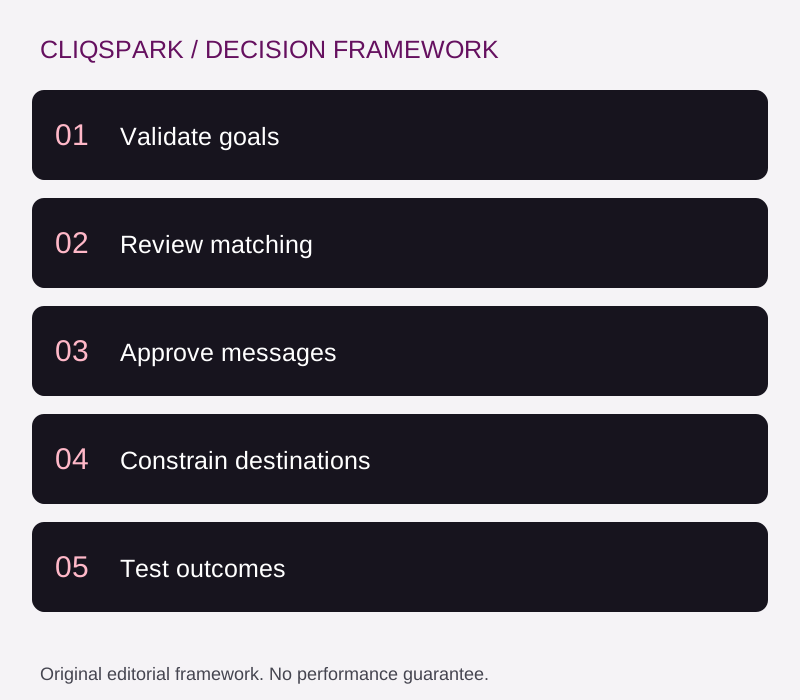
- Validate goals
- Review matching
- Approve messages
- Constrain destinations
- Test outcomes
Three controls, three different risks
Search-term matching concerns the queries the campaign can reach. The operating review is whether observed inquiries remain relevant to the service, geography and capacity you intend to support. Do not assume a broader reach is valuable simply because it creates more activity. Review the available reporting and classify the reasons for unsuitable inquiries.
Text customization concerns the message. Make sure the underlying website accurately describes the offer and that generated messages remain within approved claims. For legal advertising, the ABA's model rule on misleading communications is useful context; the applicable jurisdiction's rules require separate review. Automation does not remove professional responsibility.
Final URL expansion concerns the destination. Inspect the pages that could receive traffic. An old promotion, a general blog post or a page for an unavailable service may create a poor experience even if it contains relevant language. Maintain a reviewed destination inventory and use the controls available in the actual account. Test the landing page as a prospective customer, including its form and confirmation message.
Read experiment defaults before creating the test
Google's experiment documentation describes control and trial traffic within a campaign and provides granular controls. It also explains that text customization, final URL expansion and search-term matching are activated by default in the treatment setup, while certain brand choices can apply to both arms. Review the current setup rather than assuming a single toggle changes only one variable. Read the experiment documentation.
Write an experiment scorecard before launch: hypothesis, eligible campaign, changes being tested, primary outcome, cost guardrail, observation period, owner and decision rule. Check any automatic-application option. For an owner-led review, a deliberate decision at the end may be preferable to accepting an automated recommendation without examining inquiry quality.
A hypothetical test might ask whether the treatment produces more qualified event inquiries within an approved spending limit. It should record why inquiries are disqualified and allow enough time for qualification. If completed forms rise but unavailable-date requests dominate, that is a reason to investigate the signal and destination—not a basis for announcing revenue growth. No performance lift is assumed in this example.
What to do in the next 30 days
Use the first week to validate conversion definitions and inspect the current landing pages. Remove ambiguity from the offer and confirm who owns inquiry classification. Save a dated description of the current settings and reporting so the trial has a defensible baseline.
Use the second week to review eligibility and experiment configuration in the actual account. Document which controls change and which remain shared. Choose a decision rule that reflects the business outcome and its lag. Do not select a convenient test duration merely because the project plan says thirty days.
During the remaining weeks, monitor technical problems, unsuitable query patterns, destination accuracy and the receiving team's workload. If the test needs longer to produce meaningful evidence, state that plainly. If an approved guardrail is breached, follow the documented stop procedure. A disciplined incomplete experiment is more useful than a confident conclusion from insufficient data.
What to measure and how to decide
Report spend, inquiry volume, qualification rate, cost per qualified inquiry and later commitments when mature. State whether costs include management and operating overhead. Examine brand and non-brand interpretation carefully when shared settings change. Keep the reporting definitions stable across the comparison.
Do not repeat a vendor's aggregate performance claim as the result your business should expect. This guide intentionally supplies no universal uplift percentage. The final decision should answer whether the trial improved the defined commercial outcome within its constraints, whether the evidence is adequate and whether any message or destination risk remains. If the basic path is unreliable, use the pre-spend checklist before expanding automation. An audit can clarify readiness; it cannot guarantee future performance.
Your five-question working review
Use this as a team worksheet. Mark each item verified, needs work or unknown, and attach a dated example. An unknown is a measurement task, not evidence that the business is failing. Review one real path in depth before extrapolating to the whole organization.
- Are conversion events deduplicated and tied to an agreed business definition?
- Are website claims suitable for use in automated messages?
- Has the team reviewed potential destinations and unavailable-service pages?
- Are shared settings, treatment settings and automatic-application choices recorded?
- Does the stop rule account for spending, inquiry quality and outcome lag?
For each gap, record an owner, one corrective action and a retest date. Keep the original observation so the next review can distinguish a completed task from an actual change in customer outcomes. Avoid combining simultaneous changes when you need to understand which intervention mattered.
Sources and editorial method
Primary references checked October 22, 2026. Platform documentation can change; verify account-specific notices before acting. Frameworks and hypothetical examples are CliqSpark editorial analysis, not platform rules or observed client results.
- About AI Max for Search campaigns — Google.
- About AI Max experiments — Google.
- Model Rule 7.1: Communications Concerning a Lawyer’s Services — American Bar Association.
Choose your next step
Use the diagnostic to establish a starting point, or bring your questions to a Strategy Session.
Audit paid-search controlsDiscuss your priorities