Hospitality / October field notes
How Guests Choose Where to Book in 2026—and Where Operators Lose Them
A practical hospitality journey audit separating room reservations, dining bookings and private-event inquiries, with clear measurement and friction checks.

Follow the guest's task
A guest choosing a room, a table or a private-event venue is solving a different problem in each case. The marketing journey should reflect that. A room shopper needs dates, occupancy, rate details and terms. A diner needs a suitable location, menu and reservation path. An event buyer often needs to establish fit and availability before a proposal is possible. One generic 'Book now' button can conceal those differences.
Our recommendation is to audit the path from discovery to the actual commitment. Search, Maps, social content, referrals, intermediaries and AI-assisted research can all be starting points; this guide makes no claim about their universal share of bookings. The operational test is whether the next page preserves the visitor's purpose and provides the evidence needed to continue.
A successful click into a reservation engine is not a confirmed reservation. A private-event inquiry is not a deposit. Keep these endpoints distinct in both page copy and reporting. The objective is a buyer who understands the offer and a team that can fulfill it, rather than a dashboard filled with loosely defined conversions.
Three paths deserve three different checks
For accommodation, test the exact itinerary across the handoff. Do dates and occupancy persist? Are room names understandable? Can the guest find the conditions that matter before committing? Google's hotel free-booking-link documentation describes links that lead to a supplied landing page and discusses price accuracy and landing-page experience. It applies to hotel booking links, not restaurant or event reservations. Read the Hotel Center guidance.
For dining, inspect whether the page answers the practical questions that precede a reservation: location, menu, operating times, access and how to reserve. Use current, authorized imagery of the experience being sold. If a third-party booking service handles the next step, verify the destination and explain any material change in context.
For private events, provide a distinct inquiry path. The buyer may need capacity by layout, occasion fit, package information and a human availability check. State what the form does and what it does not do. A request for a proposal should not look like a guaranteed booking. Use the event landing-page checklist for that longer decision.
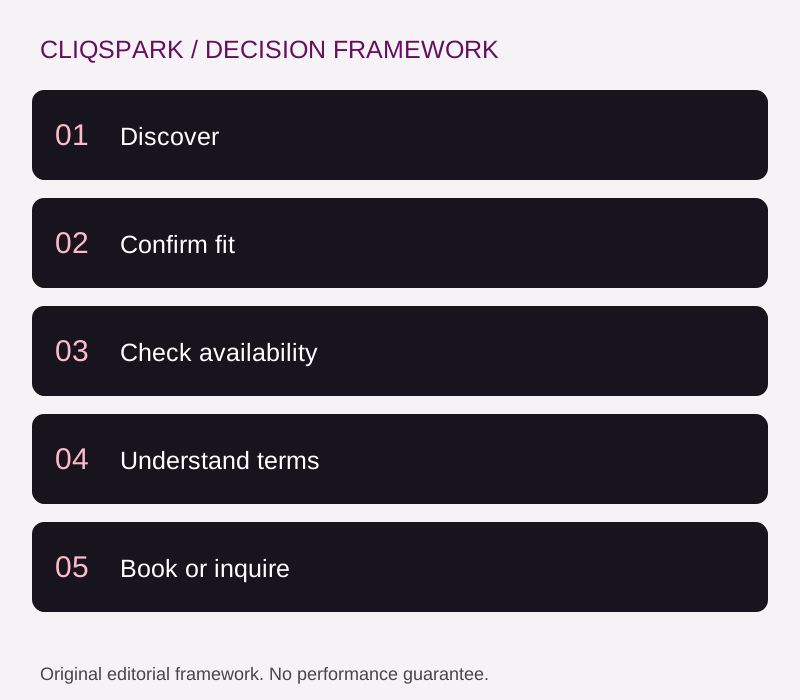
- Discover
- Confirm fit
- Check availability
- Understand terms
- Book or inquire
Make the public facts agree
Compare the website with the business profile and other maintained listings. Conflicting hours, names, addresses or contact methods can introduce doubt before the visitor reaches the booking path. Google's local guidance recommends accurate, complete information; the commercial recommendation here is to assign an owner for keeping it consistent. Google's business-profile guidance supports the information-maintenance requirement.
Use the same discipline for the offer itself. A seasonal menu, renovated room or unavailable event space needs a clear review process. A photograph should not imply a configuration the property cannot provide. Give staff a way to report mismatches they hear from guests, then correct the source page rather than relying on staff to explain it repeatedly.
AI-assisted discovery does not remove the need for these basics. Google's documentation retains standard SEO foundations for its AI search features and does not guarantee inclusion. The official AI-features guide provides context. Our inference is practical: maintain useful, consistent information for both people and systems without claiming to know every assistant's recommendation process.
Audit friction with a realistic scenario
Use a hypothetical guest with a specific task. For a hotel, choose dates and party size. For a restaurant, choose a dining occasion and time. For an event, choose a group size and preferred date. Walk the journey on a phone without using staff knowledge to fill gaps. Note every point where the visitor must restart, guess or leave the page to find essential information.
A hypothetical hotel guest might reach a booking engine that resets the selected dates. The marketing page can be accurate while the handoff is still frustrating. A hypothetical event buyer might be asked for a detailed specification before seeing whether the venue can accommodate the group. In each case, the remedy should address the observed step, not an assumed shortage of awareness.
Keep a small evidence record: starting URL, device, task, observed problem, responsible system and retest result. This method can identify defects without claiming a measured conversion uplift. If a third-party provider owns the failing step, give it a precise reproduction rather than a general complaint that bookings are down.
What to do in the next 30 days
During the first week, map the three relevant journeys for your property or group. Some businesses need only one or two. Identify the point at which the website hands responsibility to a booking system or sales team. Verify every destination and distinguish a browsing action from a completed commitment.
During the second week, correct misleading or incomplete information. Prioritize issues that change fit or availability expectations. During the third week, test forms, date selection, mobile navigation and confirmation messages. Include keyboard use and clear field labels. Do not make a real reservation merely to test a live integration; use an authorized test environment or an agreed internal procedure.
In the final week, reconcile available website events with reservation or sales records. Document where cross-domain tracking or consent limits prevent a complete connection. Improve what can be observed and leave uncertainty visible. The hospitality guide library provides focused follow-up topics once the primary friction is understood.
What to measure without inventing channel economics
Track qualified traffic, availability or inquiry starts, completion, confirmed bookings, cancellations and realized revenue where the systems permit it. Keep room, dining and event outcomes separate. A group-level total can hide a property whose handoff is failing. State the reporting period and whether the data reflects booking date, arrival date or event date.
Do not assume direct booking is always cheaper or better. Compare your actual distribution, payment, marketing and operating costs, together with cancellation and repeat-business context. A channel may provide useful demand while a direct path provides a different relationship. The decision needs property-specific economics, not a universal OTA commission claim.
For event-heavy operators, continue with the inquiry-to-deposit framework. The useful result of this audit is a verified path that matches the guest's task and produces interpretable evidence. A visibility diagnostic can reveal discovery gaps, but it cannot guarantee bookings or resolve an unavailable product.
Your five-question working review
Use this as a team worksheet. Mark each item verified, needs work or unknown, and attach a dated example. An unknown is a measurement task, not evidence that the business is failing. Review one real path in depth before extrapolating to the whole organization.
- Does the booking handoff preserve dates, party size and the selected offer?
- Can guests find material terms before committing?
- Are room, dining and event paths clearly separated where appropriate?
- Does the confirmation explain what is confirmed and what still needs a response?
- Are reporting gaps across providers and consent choices disclosed?
For each gap, record an owner, one corrective action and a retest date. Keep the original observation so the next review can distinguish a completed task from an actual change in customer outcomes. Avoid combining simultaneous changes when you need to understand which intervention mattered.
Sources and editorial method
Primary references checked October 22, 2026. Platform documentation can change; verify account-specific notices before acting. Frameworks and hypothetical examples are CliqSpark editorial analysis, not platform rules or observed client results.
- About free booking links — Google.
- Tips to improve your local ranking on Google — Google.
- AI features and your website — Google.
Choose your next step
Use the diagnostic to establish a starting point, or bring your questions to a Strategy Session.
Find the right visibility diagnosticDiscuss your priorities