Hospitality / October field notes
The Private-Event Revenue Gap: Turn More Inquiries into Confirmed Bookings
An operating framework for event inquiry ownership, qualification, proposals, follow-up, deposits and realized revenue—with transparent hypothetical economics.

The gap is often between teams
A private-event inquiry becomes commercially useful when someone can establish fit, check availability and guide the buyer toward a clear decision. A form submission alone does not do that. Marketing may generate interest, an inbox may receive it, and the event team may still lack the information or ownership needed to progress it. The operating task is to make each handoff explicit.
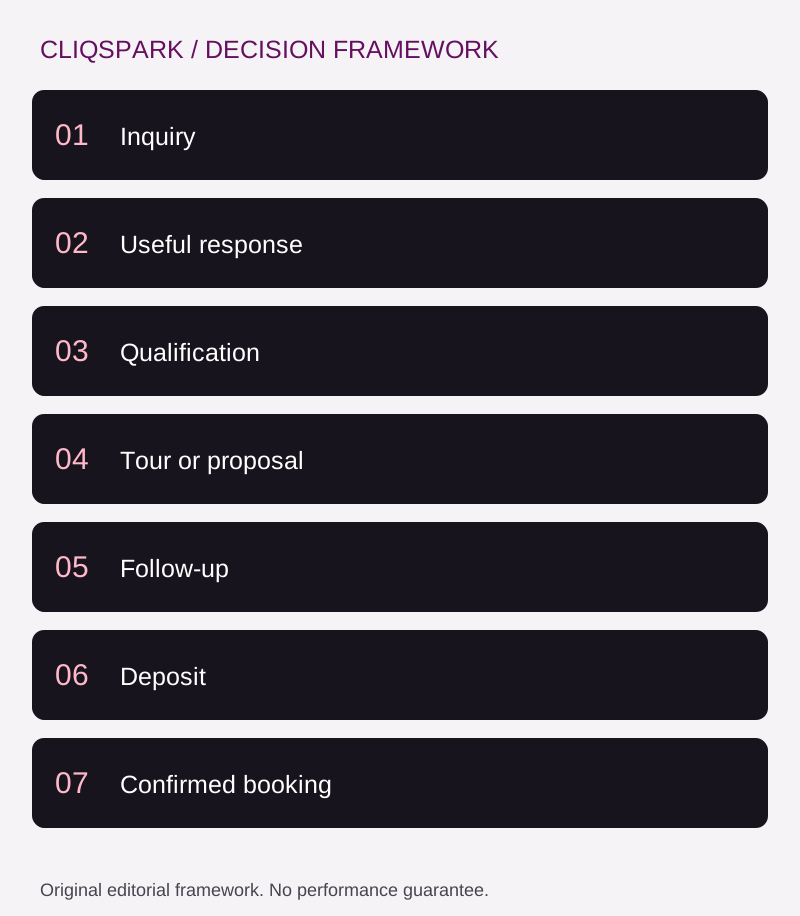
Use the full sequence: discovery → inquiry → useful response → qualification → tour or proposal → follow-up → deposit → confirmed booking → realized revenue. A particular venue may not require a tour, and its contractual confirmation process may differ. Adapt the labels to the actual business rather than forcing the business into a generic CRM template.
This guide concentrates on the sales and booking handoffs. The broader private-event marketing guide addresses demand generation. Increasing promotion can be worthwhile, but it should not be the automatic response to a queue of unowned or poorly qualified inquiries.
Make discovery and inquiry tell the same story
The event page should help a buyer understand occasion fit, space, capacity by configuration, package structure and the next step. State whether availability requires confirmation and whether a request creates any hold. Use the same descriptions in the team's response so the buyer does not encounter a different offer after submitting.
Keep location and business information accurate as well. Google's official local guidance recommends complete and up-to-date profiles. That supports a basic discovery-maintenance task; it does not prove how many event buyers use any particular channel. Read the local business guidance. This article uses no unverified group-dining growth statistic.
Ask only for information that serves a clear purpose. A preferred date, occasion, approximate party size and contact method may help the team begin. Additional requirements depend on the venue. Avoid creating a long form merely because the CRM has more fields. Equally, a form that captures too little context can move all the effort into an unnecessary exchange of emails.
- Inquiry
- Useful response
- Qualification
- Tour or proposal
- Follow-up
- Deposit
- Confirmed booking
Define a useful response, not just an acknowledgment
An automatic receipt confirms that a message arrived. A useful response advances the buyer's decision. It can acknowledge the requested occasion, confirm what is known about availability, identify the next missing detail and name the person responsible. Keep any promised response window aligned with staffing, weekends and holidays.
Assign an owner and backup at the point of receipt. Record the next action and when it is due. If several properties share an inbox, make transfer rules visible so an inquiry does not disappear between teams. If another property is a better fit, explain the alternative and preserve the context already provided by the buyer.
Use qualification to understand fit rather than to dismiss inconvenient requests without learning. Record whether the obstacle is date availability, capacity, budget, format, timing or an unanswered question. Those reasons can improve page content and package design. Do not treat every lost inquiry as a marketing-quality failure or every unanswered proposal as a price objection.
A hypothetical booking-economics example
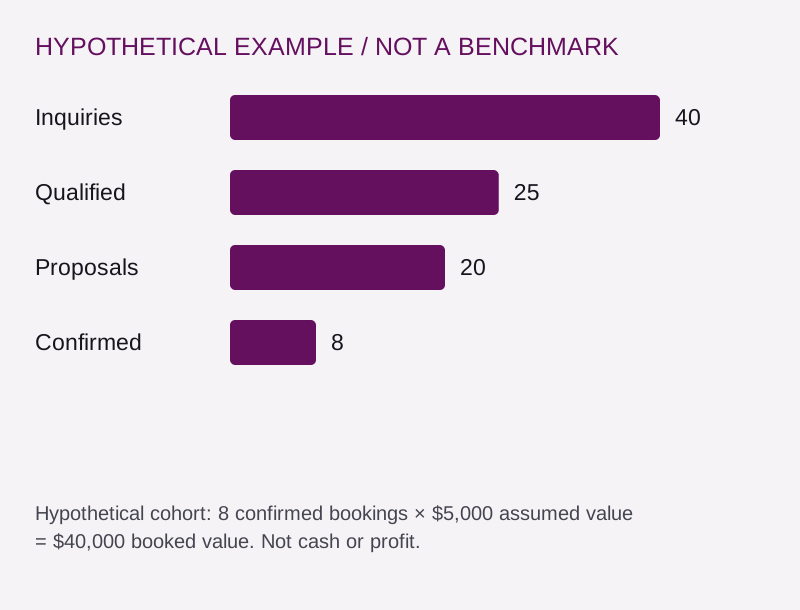
Assume a fictional venue receives 40 inquiries in a defined cohort. Twenty-five are qualified under its own criteria, 20 receive suitable proposals and eight become confirmed bookings. Assume an illustrative average booked value of $5,000. The model therefore records $40,000 in booked value. These inputs are invented, not market benchmarks, a client result or a forecast.
If two additional proposals convert at the same assumed value, the model adds $10,000 in booked value. It does not add $10,000 in profit or necessarily collected cash. Delivery costs, cancellation terms, taxes, service charges and the timing of payments need separate treatment. The arithmetic is useful only when the labels remain honest.
Now examine the operational question behind the scenario. Were proposals unanswered because the buyer lacked a clear next step, because the date was no longer available or because the offering was unsuitable? A follow-up reminder cannot solve every reason. Improve the relevant handoff and observe what happens; do not infer that a CRM automation will deliver the hypothetical result.
Give proposals and follow-up a decision structure
A proposal should make the offered experience, included items, material conditions and acceptance process understandable. Version it so the buyer and team are discussing the same offer. Record tentative holds separately from confirmed bookings, and make any expiry or release process clear under the venue's own policy.
Each follow-up should help answer a real question: is the date still relevant, does the package fit, is another decision-maker involved, or is there a concern that should be resolved? Respect opt-outs and the buyer's preferences. Avoid an automated sequence that keeps asking for a booking after the person has declined or the date has passed.
Use the follow-up sequence guide as a starting point, then adapt it to staffing and the length of the buying process. The best cadence is one the team can maintain responsibly and evaluate. This article does not claim a universal number of follow-ups or a guaranteed response-time conversion effect.
What to do in the next 30 days
In week one, map the inquiry path for one venue and inspect a defined sample. Confirm where messages arrive, who sees them and how ownership is recorded. Identify any inquiry with no owner or next action. Protect guest information while reviewing the process.
In week two, standardize the minimum qualification fields and the meaning of each stage. Agree on what creates a confirmed booking and how cancellations are recorded. In week three, revise the response and proposal templates around the buyer's decision. Test the handoff with staff using fictitious internal examples, not unsolicited messages to real prospects.
In week four, review outstanding opportunities and lost reasons. Compare the process with the original sample, but do not present a small before-and-after observation as causal proof. Choose the next constraint only after the first change has been implemented consistently. The goal is a repeatable operating rhythm rather than a one-time inbox cleanup.
What to measure
Monitor inquiry counts, qualification, useful-response timing, proposals, confirmed bookings and the value associated with each stage. Define whether response time includes nights and closed periods. Keep overdue next actions visible. Report deposit status separately from total contract value, and reconcile realized revenue after the event.
For multi-property groups, use common definitions but retain property-level context. One venue may lack availability while another lacks response coverage. An average can hide both problems. The event marketing ROI guide helps connect costs and outcomes without equating booked value with profit. A revenue-leakage diagnostic can organize this review; it cannot guarantee that additional inquiries will become confirmed events.
Your five-question working review
Use this as a team worksheet. Mark each item verified, needs work or unknown, and attach a dated example. An unknown is a measurement task, not evidence that the business is failing. Review one real path in depth before extrapolating to the whole organization.
- Does every new inquiry have an owner, backup and next action?
- Does the first useful response address availability or the next missing detail?
- Are proposal versions, tentative holds and confirmed bookings distinct?
- Do follow-ups stop when an inquiry is declined or no longer relevant?
- Are deposits, booked value, cancellations and realized revenue reconciled separately?
For each gap, record an owner, one corrective action and a retest date. Keep the original observation so the next review can distinguish a completed task from an actual change in customer outcomes. Avoid combining simultaneous changes when you need to understand which intervention mattered.
Sources and editorial method
Primary references checked October 22, 2026. Platform documentation can change; verify account-specific notices before acting. Frameworks and hypothetical examples are CliqSpark editorial analysis, not platform rules or observed client results.
Choose your next step
Use the diagnostic to establish a starting point, or bring your questions to a Strategy Session.
Find event-revenue leakageDiscuss your priorities