AI & Trust / October field notes
AI Search in 2026: What Google's Guidance Actually Means for Your Business
Separate documented Google AI-search requirements, new visibility reporting and useful content improvements from unsupported citation promises.

The practical answer
Keep the technical foundations of SEO, publish useful and verifiable information, and inspect the entire journey after the search result. Google does not describe a special schema or optimization trick that guarantees AI Overviews or AI Mode inclusion. Its guidance leaves room for original analysis and clearer explanations; it does not justify selling certainty about citations. The owner-level decision is where your content or customer journey is weak enough to warrant investment.
This guide separates three categories. Documented facts describe what Google says its systems or reports do. Operating recommendations describe work CliqSpark believes can make a page more useful and manageable. Attribution limits describe what the available evidence cannot establish. That distinction matters when an agency offers a score with no visible method or turns a changing sample of AI answers into a revenue forecast.
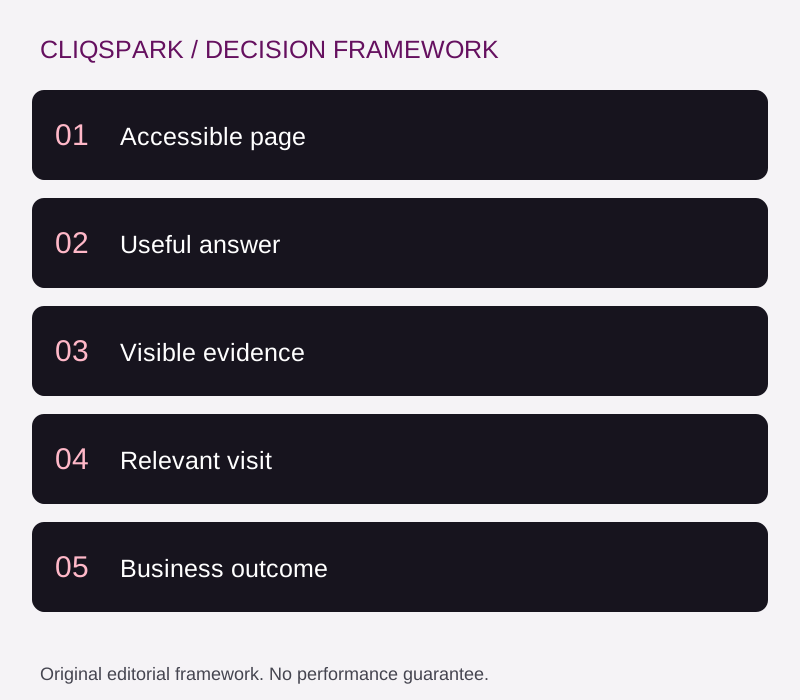
A technically accessible page can still be unhelpful. A polished answer can still lack the evidence a buyer needs. And a useful visit can still lead to a broken form. Your review should therefore connect discoverability, comprehension and conversion instead of assigning the entire problem to a new acronym.
Start with the documented requirements
Google says a page must be indexed and eligible for a snippet to qualify as a supporting link in its AI search features. It also says that meeting requirements does not guarantee crawling, indexing or serving. Those are eligibility conditions, not an inclusion contract. The official AI-features documentation is the source for these distinctions.
Check your important page as a public visitor would encounter it. Does it return a successful response? Is the intended page the canonical version? Can crawlers access the substantive text? Does the page link to supporting details, and do other relevant pages link back to it? A JavaScript feature should not be the only place an essential service fact exists.
Google's generative-AI optimization guide provides additional official context. Our practical recommendation is to keep a change register with the source, date checked and affected page. A crawl date is not a product-launch date. Revisit an old recommendation when newer documentation changes the reporting or implementation context.
- Accessible page
- Useful answer
- Visible evidence
- Relevant visit
- Business outcome
Build pages that can support a decision
Start with one question a prospective customer actually needs answered. A PI practice-area page might explain the kinds of inquiries the firm evaluates, where it practices and what an initial discussion involves. A venue page might explain room configurations, realistic capacities, accessibility arrangements and the process for checking date availability. Replace vague superlatives with specific, maintainable information.
Place evidence where a reader encounters the claim. A source list at the bottom is useful, but it should not force the reader to guess which source supports a number. Give examples a visible label when they are hypothetical. Give operating recommendations an owner and a review cadence. Distinguish a business's genuine experience from an inference about a platform's behavior.
An annotated page can be evaluated in five passes: the title states the question; the opening provides an answer; the main sections explain conditions and exceptions; the source links support external claims; the next step fits the decision. This is an editorial review method, not a ranking-factor checklist. The existing citation-readiness framework offers a broader maintenance process.
A material 2026 reporting update
Google announced Search Generative AI performance reports on June 3, 2026, and its announcement includes an August 31 note stating worldwide rollout. The described views include impressions and breakdowns such as pages, countries, devices for Search, and dates. This newer announcement matters when interpreting older advice that describes only aggregate reporting. Read Google's dated announcement and rollout note.
Use the actual reports available in your verified property and document their definitions. A visibility impression is not a booked appointment, qualified case opportunity or completed stay. Do not manufacture click-through rates where the necessary metric is unavailable. Do not infer that every visitor who later converts saw an AI result. Keep platform visibility evidence alongside, rather than silently merged into, your website and operational records.
For an illustrative review, suppose an event page begins appearing in a visibility report while its inquiry count stays flat. That observation can motivate a page and booking-path audit. It does not establish that the AI exposure failed, that a specific paragraph caused inclusion or that the page needs a different schema. Record the uncertainty and test the next controllable step.
What to do in the next 30 days
First, inventory the pages that explain your highest-value services. Assign each one a distinct question and audience. Compare titles, introductions and calls to action for duplication. Consolidate genuinely redundant material through a considered editorial plan; do not delete useful URLs simply to make the index shorter.
Next, check access, canonical URLs, headings, visible author or publisher identity and primary evidence. Review structured data against what the page actually shows. Google's Article documentation explains article markup; adding it does not create evidence or guarantee a particular search presentation.
Then improve one page with a better answer, an original example and a precise next step. Record publication changes and the date of source review. In the final week, inspect the relevant reporting, validate the CTA on mobile and ask the receiving team whether the page sets accurate expectations. Keep the change small enough to understand.
What to measure and avoid
Maintain three separate views: technical availability, search visibility and commercial progress. Technical checks cover access and rendering. Visibility checks use the current platform reports and a disclosed sampling method for any manual assistant checks. Commercial checks cover qualified inquiries and downstream outcomes, with privacy controls appropriate to your business.
Avoid promises of guaranteed mentions, proprietary 'GEO schema' presented as a Google requirement, fake first-hand evidence and invisible text aimed at machines. An answer should withstand a reader opening its sources. For a practical assessment, combine this documentation-led review with the controllable-readiness guide and the customer-selection framework. The goal is a more useful, testable publishing system, not an impressive vocabulary.
Your five-question working review
Use this as a team worksheet. Mark each item verified, needs work or unknown, and attach a dated example. An unknown is a measurement task, not evidence that the business is failing. Review one real path in depth before extrapolating to the whole organization.
- Is the page accessible, indexable and eligible to appear with a snippet?
- Does the introduction answer one specific customer question?
- Can a reader distinguish documented requirements from our recommendations?
- Do the visible content, canonical URL and structured data describe the same page?
- Which report and definition support each visibility claim in the monthly review?
For each gap, record an owner, one corrective action and a retest date. Keep the original observation so the next review can distinguish a completed task from an actual change in customer outcomes. Avoid combining simultaneous changes when you need to understand which intervention mattered.
Sources and editorial method
Primary references checked October 22, 2026. Platform documentation can change; verify account-specific notices before acting. Frameworks and hypothetical examples are CliqSpark editorial analysis, not platform rules or observed client results.
Choose your next step
Use the diagnostic to establish a starting point, or bring your questions to a Strategy Session.
Review AI-search readinessDiscuss your priorities