AI & Trust / October field notes
Being Found Is No Longer Enough. You Need to Be Chosen.
A five-part decision framework for turning search and AI visibility into customer confidence, qualified inquiries and measurable commercial progress.

The decision happens after discovery
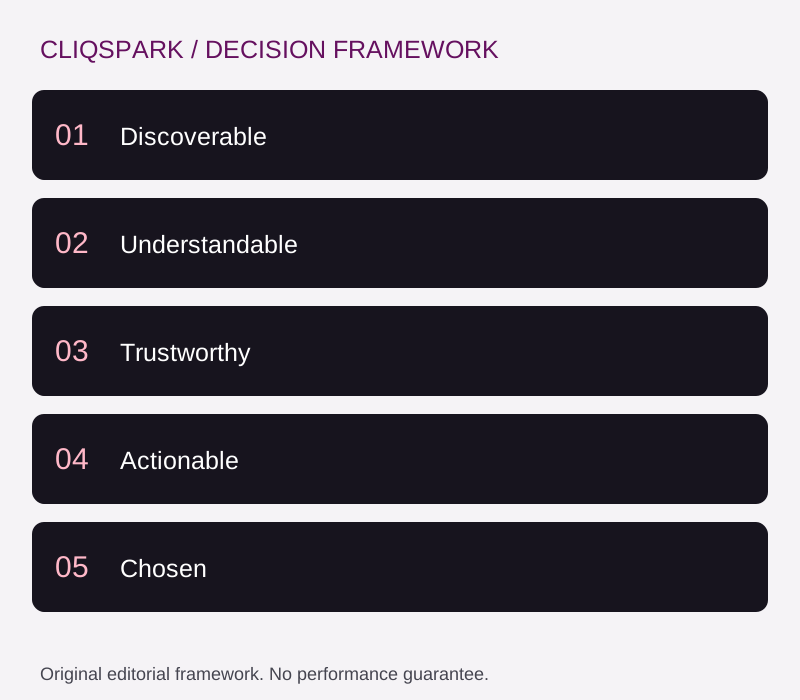
A business can appear in a search result and still be difficult to choose. The visitor may not understand the service, find evidence relevant to their situation, or see a workable next step. More exposure will not automatically resolve those problems. CliqSpark's recommendation is to inspect the whole decision path: discoverable, understandable, trustworthy, actionable and chosen. This is our operating framework, not a ranking model or a promise of growth.
For a personal injury firm, the desired outcome is an appropriate inquiry that can move through responsible intake toward a signed engagement. For a hotel, restaurant or venue, it may be a room reservation, dining booking or qualified event conversation. Those outcomes have different friction points. A useful marketing review starts with the decision the buyer must make, rather than treating all visits and form fills as interchangeable.
The executive question is simple: what is the first unresolved doubt that prevents a suitable customer from moving forward? You need enough visibility to enter consideration, enough clarity to demonstrate fit, enough credible evidence to reduce uncertainty, and an action the business can actually fulfill. Measure each stage separately so success at one stage cannot conceal failure at the next.
Five conditions for being chosen
Discoverable means a suitable buyer can encounter you through relevant channels. Google's documented AI-search guidance keeps standard SEO foundational and does not guarantee inclusion. Treat a visibility diagnostic as a way to identify obstacles, not to purchase a citation. Google's AI-features guidance is the platform reference; the five-condition framework here is CliqSpark's interpretation.
Understandable means someone can tell who you serve, what you offer, where you operate and what happens next. Test this without explaining the page yourself. If a colleague needs to translate your service language, the page is asking a prospective customer to do unnecessary work. A precise answer to a practical question often contributes more than another broad claim about excellence.
Trustworthy means the evidence fits the decision. Relevant credentials, accurate service details, identifiable authorship, genuine reviews and transparent limitations can help a buyer evaluate risk. Google's local guidance also emphasizes complete business information and reviews. That does not establish how every AI assistant weighs trust. Read the local-ranking guidance before turning an operating checklist into an algorithm claim.
Actionable means the next step is specific and usable. A prospective client should understand the purpose of an initial conversation. A guest should know whether a button checks availability, requests an event proposal or completes a reservation. Chosen means the business can confirm that an appropriate commitment occurred. A click, an inquiry, a consultation and collected revenue are distinct events.
- Discoverable
- Understandable
- Trustworthy
- Actionable
- Chosen
Follow the constraint, not the loudest metric
Use a second sequence to locate responsibility: demand → visibility → trust → conversion → follow-up → revenue. Demand describes the opportunity you are trying to serve. Visibility and trust concern whether the right people encounter and understand your offer. Conversion and follow-up concern whether the organization can progress an inquiry. Revenue closes the learning loop after cancellations, disqualification and delivery are accounted for.
A hypothetical venue illustrates the difference. Its event page gets suitable visitors, but the inquiry form asks only for an email address. The sales team must start a new conversation to learn the occasion, date and group size. Adding advertising may enlarge that queue. A better first intervention may be a short, accessible form that captures the minimum planning context and states who will respond. This example is an operating hypothesis, not a measured client result.
Now consider the opposite case: a clear page and responsive team with too few relevant visitors. Improving follow-up alone cannot create missing demand. The same framework points toward discoverability. The discipline is to locate the evidence for the constraint, assign an owner and define what would show that the intervention worked. Avoid diagnosing every business with the service you happen to sell.
What to do in the next 30 days
During the first week, choose one commercial journey and write its intended endpoint. Walk it on a phone from a search result, a referral and a direct visit. Record unanswered questions, broken handoffs and conflicting details. Use a small, clearly described sample of actual inquiries when authorized; do not expose personal or case information in a marketing worksheet.
In week two, rank issues by customer impact, confidence in the evidence and effort. Choose one meaningful constraint. Rewrite the relevant explanation, repair the booking or contact path, or clarify the response responsibility. Document the original state so that a later improvement is not attributed to memory.
Use weeks three and four to observe the revised journey. Ask the receiving team whether inquiry quality or completeness changed. Keep a short change log and compare similar periods, noting promotions, staffing and seasonality. If the sample is too small, keep collecting evidence rather than declaring victory. The month should end with a better decision, not an invented uplift percentage.
What to measure—and what can mislead
Track a compact chain: relevant visits, meaningful action starts, completed inquiries, qualified inquiries, next-stage commitments and eventual outcomes. Define qualification before reporting it. A PI firm's acceptance decision and a venue's availability decision are operational judgments, not interchangeable conversion labels. Record lost reasons so marketing can learn whether fit, capacity, timing or follow-up caused the loss.
Do not treat every drop between stages as a defect. Some inquiries should be declined. Do not assume an AI mention caused a booking simply because both appeared in the same week. Keep observed facts separate from attribution assumptions. A diagnostic can expose missing evidence and suggest priorities; it cannot guarantee that a platform will recommend you or that a buyer will choose you.
Use the revenue visibility framework to connect the measures, and the local visibility guide when discovery is the constraint. For firms whose inquiries are already arriving, the signed-case economics walkthrough helps distinguish volume from commercially useful progress.
Your five-question working review
Use this as a team worksheet. Mark each item verified, needs work or unknown, and attach a dated example. An unknown is a measurement task, not evidence that the business is failing. Review one real path in depth before extrapolating to the whole organization.
- Can a suitable buyer identify the service and geography without opening another page?
- Which claim has a current primary source or directly observable proof?
- Does the CTA explain what happens after the click?
- Who owns the inquiry, and can the team fulfill the promise on the page?
- Which stage is currently least observable, and what evidence would resolve it?
For each gap, record an owner, one corrective action and a retest date. Keep the original observation so the next review can distinguish a completed task from an actual change in customer outcomes. Avoid combining simultaneous changes when you need to understand which intervention mattered.
Sources and editorial method
Primary references checked October 22, 2026. Platform documentation can change; verify account-specific notices before acting. Frameworks and hypothetical examples are CliqSpark editorial analysis, not platform rules or observed client results.
- AI features and your website — Google.
- Tips to improve your local ranking on Google — Google.
Choose your next step
Use the diagnostic to establish a starting point, or bring your questions to a Strategy Session.
Check your AI visibilityDiscuss your priorities