Personal Injury / October field notes
Why More Personal Injury Leads Don't Necessarily Mean More Signed Cases
A transparent, hypothetical PI intake model that separates lead cost, qualification, contact, consultations, signed cases and realized revenue.

The owner-level answer
More leads produce more signed cases only when the additional inquiries are appropriate and the firm can progress them. Lead cost alone cannot show that. A useful model separates inquiry volume, qualification, successful contact, consultations, signed engagements and eventual collected revenue. The purpose is to find an operational constraint and make spending decisions with clearer evidence, not to assign a theoretical value to every person who contacts the firm.
Start with a shared definition of an inquiry. Separate duplicate contacts, existing clients, vendors and irrelevant requests from new prospective matters. Then define qualification using the firm's own approved criteria. Do not let a marketing vendor's definition quietly replace the intake team's decision. A platform conversion can represent contact rather than a signed engagement; Google's pay-per-lead documentation provides one concrete example of that distinction.
This article adds a transparent economics model to the existing guide to why leads stall. It does not supply industry conversion benchmarks, predict case value or recommend accepting unsuitable matters.
Write the funnel so every denominator is visible
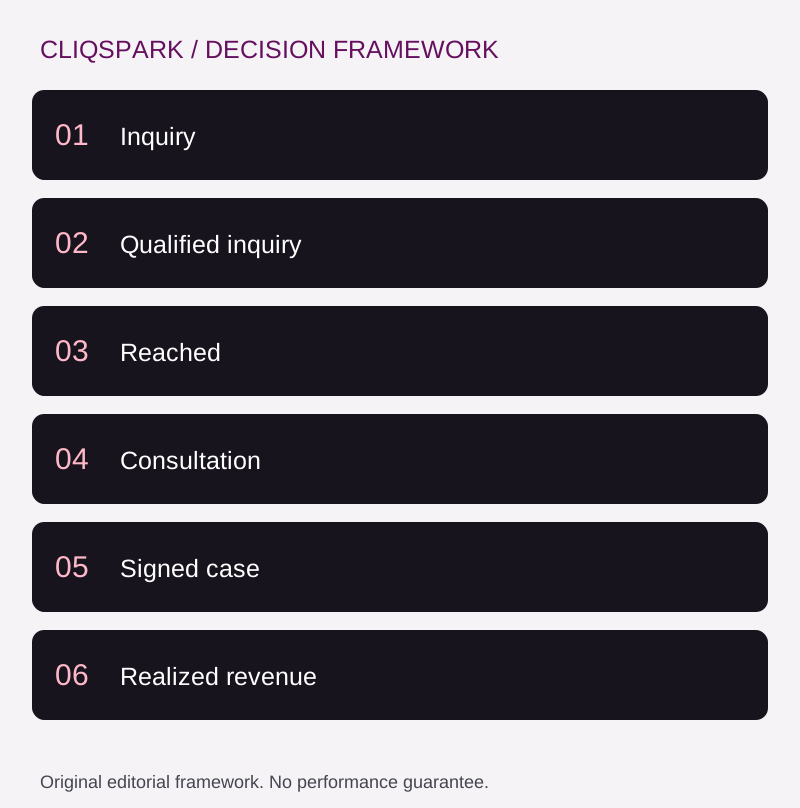
Use a sequence that your team can reconcile: click → inquiry → qualified inquiry → reached → consultation → signed case → realized revenue. Not every inquiry begins with a trackable click, so retain a source category for referrals, direct contacts and unknown sources. Do not force an invented click history onto a person who called after hearing about the firm elsewhere.
For each transition, record the count entering the stage, the count progressing and the observation period. Contact rate among qualified inquiries differs from contact rate among all inquiries. Consultation completion differs from appointments scheduled. A signed engagement differs from a matter that ultimately produces revenue. Mixing these denominators can make a dashboard appear precise while making the decision less reliable.
Assign stage ownership. Marketing can improve targeting and expectation-setting. Intake can improve routing, contact and documentation. Lawyers make appropriate professional judgments. Finance can reconcile realized outcomes. The point is shared learning, not a scoreboard that rewards one team for transferring the problem to another.
- Inquiry
- Qualified inquiry
- Reached
- Consultation
- Signed case
- Realized revenue
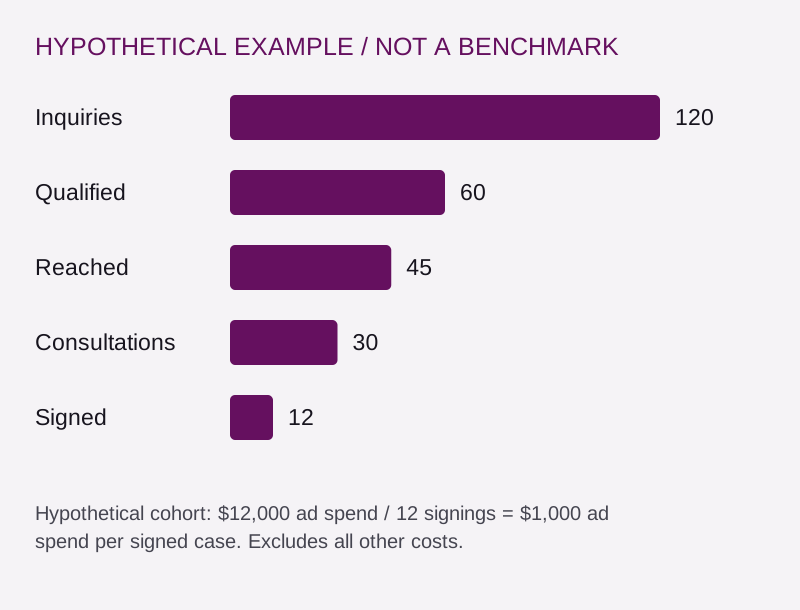
A hypothetical scenario, not a benchmark
Assume a fictional firm spends $12,000 and receives 120 new inquiries in one measured cohort. Sixty meet its defined qualification criteria. The team reaches 45 of those people, completes 30 consultations and signs 12 engagements. These are invented inputs for arithmetic only; they are not typical PI results, a CliqSpark case study or a forecast.
The simple calculations are $100 per inquiry, $200 per qualified inquiry and $1,000 in advertising spend per signed case. These figures exclude staff time, software, vendor fees, case costs and other overhead. Calling the last figure a fully loaded acquisition cost would be misleading. If you include additional costs, list them and use the same definition consistently.
Now hold spend and qualification constant. Suppose improved routing allows 54 qualified inquiries to be reached. If the hypothetical consultation-per-contact rate stays at two-thirds and the signed-case-per-consultation rate stays at 40%, the expected model produces 36 consultations and 14.4 signed cases. Actual cases are whole numbers; 14.4 is a scenario expectation. The implied advertising cost is about $833 per expected signed case. No evidence here establishes that the intervention will cause those rates.
The model reveals a question worth investigating: are suitable people being lost before a meaningful conversation? It does not prove that faster response is always the best investment. If qualification is the weak stage, adding contact capacity may simply process more unsuitable inquiries. If capacity is already full, additional signed matters may introduce a different constraint.
Build a measurement scorecard the firm can defend
Use one row per inquiry with a protected identifier, source, received time, qualification status, contact status, consultation outcome and signed status. Store sensitive details in the firm's approved systems, not analytics events or public spreadsheets. In marketing reports, use the minimum aggregated information needed to understand performance.
Track the time between stages and the reasons an inquiry stops. Separate an unanswered call from a person who declined, an unavailable service from a geographic mismatch, and an unsuitable matter from a missing follow-up. Each reason suggests a different remedy. Avoid labeling every non-conversion as an intake failure.
Compare cohorts with enough time to mature. A recent campaign may appear weak simply because consultations have not occurred yet. Conversely, counting old signed cases against this month's spend can make current acquisition look artificially efficient. Keep the cost-per-signed-case calculation tied to its stated attribution window.
What to do in the next 30 days
First, reconcile a manageable sample of recent inquiries with the intake team. Agree on definitions and identify duplicates or missing sources. Document gaps rather than filling them with guesses. Then trace the largest meaningful loss between stages. Ask whether it is caused by fit, response ownership, scheduling, capacity or incomplete records.
In the second half of the month, test one operational improvement: a routing correction, a defined response owner, a clearer appointment explanation or a revised qualification handoff. Set a review date and a practical success criterion. Do not promise a response speed the firm cannot sustain outside normal staffing hours.
At the end of the month, report what changed, what was observed and what remains uncertain. Include the number of inquiries reviewed and the period covered. Use the PI dashboard guide to keep the report focused on decisions. A small sample can identify process defects without proving a causal conversion lift.
Revenue and ethical limits
Keep projected economics separate from realized fees and collections. Timing, outcomes and costs can differ substantially by matter. A signed engagement is not cash, and an illustrative average must not be presented as a promise to a prospective client. The ABA's Model Rule 7.1 addresses misleading communications; applicable state rules and professional judgment govern the firm's advertising and intake practices.
The commercial takeaway is to improve the quality of the decision before buying more volume. A revenue-leakage diagnostic can organize the questions and reveal missing measurements. It cannot determine case merits, guarantee signed clients or substitute for the firm's own financial and professional review.
Your five-question working review
Use this as a team worksheet. Mark each item verified, needs work or unknown, and attach a dated example. An unknown is a measurement task, not evidence that the business is failing. Review one real path in depth before extrapolating to the whole organization.
- Are duplicates excluded consistently from the inquiry denominator?
- Are qualification criteria approved by the firm rather than inferred by marketing?
- Does the report distinguish scheduled from completed consultations?
- Does cost per signed case disclose which costs and attribution window it includes?
- Are recent cohorts allowed to mature before being compared with older ones?
For each gap, record an owner, one corrective action and a retest date. Keep the original observation so the next review can distinguish a completed task from an actual change in customer outcomes. Avoid combining simultaneous changes when you need to understand which intervention mattered.
Sources and editorial method
Primary references checked October 22, 2026. Platform documentation can change; verify account-specific notices before acting. Frameworks and hypothetical examples are CliqSpark editorial analysis, not platform rules or observed client results.
- Model Rule 7.1: Communications Concerning a Lawyer’s Services — American Bar Association.
- Performance Max campaigns with pay-per-lead goals — Google.
Choose your next step
Use the diagnostic to establish a starting point, or bring your questions to a Strategy Session.
Find the revenue leakageDiscuss your priorities