AI & Trust / October field notes
When Customers Ask AI Who to Trust: The New Local Reputation Checklist
Audit the consistency, legitimacy and practical usefulness of local reputation signals without buying reviews or promising AI recommendations.

Trust is a consistency problem before it is a score
A prospective customer may encounter a recommendation in one place and validate it somewhere else. Treat that as a reason to make your public evidence coherent, not as proof of a universal AI recommendation formula. Your website, business profile, review responses and booking or intake experience should describe the same business. An impressive rating cannot explain away an incorrect location, an unclear service or an unanswered inquiry.
The useful owner-level question is whether a reasonable person can verify the claims that matter to their decision. A law firm needs accurate practice and professional information. A hotel needs a trustworthy description of the stay. A restaurant or private-event venue needs evidence about the actual experience being sold. The same reputation process should not flatten these different decisions into one generic review request.
This checklist does not use a consumer-survey percentage. No market-wide claim about how often people consult AI is necessary to justify keeping information accurate and feedback legitimate. It also does not promise that an assistant will recommend a business after the checklist is completed.
Build the trust signal stack
Start with identity: the public business name, relevant location, contact method, hours and service information. Google's local-ranking guidance discusses relevance, distance and prominence, and recommends complete business information. These are documented local-search considerations, not a disclosed weighting system for every AI assistant. Review Google's local guidance.
Add decision-specific proof. A venue should show the room a buyer is considering, describe its configurations accurately and explain how availability is confirmed. A firm should make professional identity and service scope understandable. Use real, authorized materials. A photograph of an unrelated property or a sweeping outcome claim can make the page look polished while weakening the underlying evidence.
Then review feedback and response practice. Look for themes, not just a favorable average. Are people confused about who will contact them? Do guests mention a discrepancy between the listing and the experience? Does the business respond constructively without exposing personal information? These observations should enter an operations discussion, where someone can change the underlying experience.
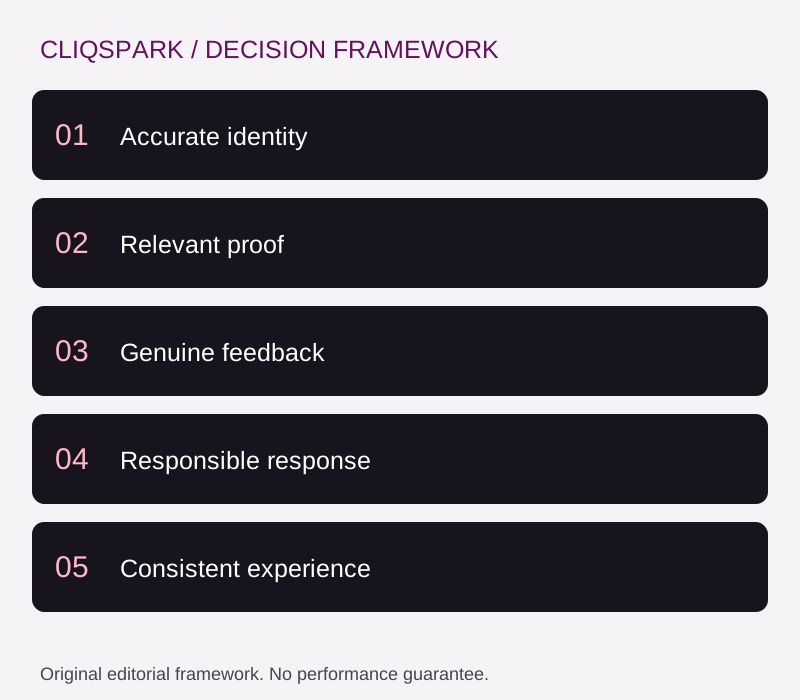
- Accurate identity
- Relevant proof
- Genuine feedback
- Responsible response
- Consistent experience
Legitimate review requests are an operational policy
Google's Maps policy prohibits incentivized reviews and selective solicitation of positive reviews. Ask for genuine feedback without trying to control its rating or content. The official review policy is the reference. Build the process around eligibility, permission and a consistent trigger, rather than a campaign to create a burst of praise.
Write a short internal policy stating who can send a request, when it is appropriate and how opt-outs are respected. Keep a feedback route available when someone needs help. Do not use a private satisfaction question to send happy customers to public reviews while diverting unhappy customers away. Do not offer a discount, gift or fee reduction in exchange for a review.
For legal services, reputation work also needs professional review. The ABA's Model Rule 7.1 addresses false or misleading communications about a lawyer's services; it is a model rule, not a substitute for the applicable jurisdiction's rules. Read the ABA rule. Have responsible counsel review advertising claims and response practices. Never use a public reply to disclose case details.
A practical example: the promise mismatch
Consider a hypothetical restaurant group whose private-event page advertises an intimate room while the inquiry reply offers a different shared space. The marketing team may see a reputation problem; the sales team may see weak leads. The first issue to investigate is the promise mismatch. Which space did the buyer believe they were requesting, and where did that expectation originate?
Create a single maintained description for each bookable space, with approved images, layouts and practical restrictions. Link the inquiry to that space and explain alternatives explicitly. If a reviewer raises the same confusion, acknowledge the concern appropriately and fix the source of the misunderstanding. This is an illustrative operating scenario, not a reported CliqSpark client result.
The lesson is to audit the evidence before increasing review volume. If the underlying promise remains inconsistent, a larger audience simply encounters the same problem. The review pace guide addresses maintenance rhythm; this checklist addresses the integrity of what the buyer is being asked to trust.
What to do in the next 30 days
In week one, assemble the public records for one location or service line. Compare names, hours, service descriptions, images and destination links. Correct consequential conflicts first. Keep a record of who controls each listing so a future change does not leave an abandoned version behind.
In week two, sample recent feedback using a disclosed period and method. Group observations into clarity, delivery, responsiveness and fit. Avoid treating a handful of reviews as representative research. Assign the recurring operational issues to an owner and decide how their resolution will be checked.
In week three, review the request and response process. Remove incentives and rating steering, clarify consent and escalation, and prepare response principles rather than robotic copy. In week four, test the complete path from profile to website to inquiry. Confirm that the team can deliver what the public page promises. Use the local visibility assessment to separate missing information from broader discovery problems.
What to measure
Track information defects corrected, review-request coverage among eligible customers, response ownership and recurring complaint themes. If you report review volume or ratings, state the platform and period. Do not blend incompatible platform scores into an invented reputation index. For a business with several locations, examine differences before presenting a group average.
Also measure whether inquiries arrive with accurate expectations. A reduction in confusion can be valuable even if the star rating does not move. Keep any assistant-recommendation monitoring explicitly observational: prompts, date, location assumptions and outputs can vary. Use the AI-search guidance review to keep documented platform facts separate from marketing interpretations. Trust is earned through a consistent experience and defensible evidence; a checklist can organize that work, but cannot guarantee selection.
Your five-question working review
Use this as a team worksheet. Mark each item verified, needs work or unknown, and attach a dated example. An unknown is a measurement task, not evidence that the business is failing. Review one real path in depth before extrapolating to the whole organization.
- Do maintained profiles agree on name, location, hours and contact methods?
- Are review requests neutral and free of incentives or positive-only selection?
- Do public responses avoid exposing client or guest information?
- Is each credential, award or claim current and accurately described?
- Who can correct conflicting information when a customer reports it?
For each gap, record an owner, one corrective action and a retest date. Keep the original observation so the next review can distinguish a completed task from an actual change in customer outcomes. Avoid combining simultaneous changes when you need to understand which intervention mattered.
Sources and editorial method
Primary references checked October 22, 2026. Platform documentation can change; verify account-specific notices before acting. Frameworks and hypothetical examples are CliqSpark editorial analysis, not platform rules or observed client results.
- Tips to improve your local ranking on Google — Google.
- Prohibited and restricted content — Google.
- Model Rule 7.1: Communications Concerning a Lawyer’s Services — American Bar Association.
Choose your next step
Use the diagnostic to establish a starting point, or bring your questions to a Strategy Session.
Review your reputation processDiscuss your priorities